NAD+ precursors · NMN
Best NMN supplements compared by the evidence
NMN can raise NAD+ markers in early human trials, but proven health outcomes are still thin. Here is how to compare NMN supplements honestly — and what the evidence does not yet support.
NMN sits inside the wider family of NAD boosters, and it is bought on a single idea: NAD+ is a coenzyme central to energy metabolism and cellular repair, its levels fall with age, and topping it up might slow some aspects of ageing. That premise is reasonable and actively researched — but "reasonable premise" is not the same as "proven benefit," and most product pages blur that line. This one will not.
What NMN is and why people take it
NMN is a molecule your body uses on the way to making NAD+. Because oral NAD+ itself is poorly absorbed, supplement makers use precursors like NMN and nicotinamide riboside (NR) that the body can convert. If you want the plain-language version of how these molecules relate, we cover it in NMN vs NAD vs NR. The core longevity claim for NMN is indirect: raise NAD+, and downstream repair pathways may work a little better.
What the human evidence actually shows
Here the honesty matters most. A small randomised, placebo-controlled trial in prediabetic postmenopausal women found that NMN improved muscle insulin sensitivity — a genuine, peer-reviewed human result.[1] Independent evidence summaries also note that NMN can raise NAD+-related blood markers, while cautioning that broad clinical benefits are not established.[2] Across the NAD+ precursor field, NR currently carries more human data — including a study of its oral bioavailability[3] and a randomised trial showing it raises NAD+ and is well tolerated in older adults.[4] The key caveat runs through all of it: raising a marker is not the same as a proven outcome. Living longer or healthier on NMN has not been demonstrated in people.
Early human data · outcomes unprovenWhy "raises NAD+" keeps failing to become "improves something"
The NAD+ precursor field has run the experiment that ought to settle this, more than once, and the answer has been consistent. A randomised placebo-controlled trial gave obese men 2 grams of NR per day for twelve weeks — several times a typical commercial dose — and found it safe but with no improvement in insulin sensitivity, lipid mobilisation or body composition.[5] A separate study in aged human skeletal muscle successfully raised the muscle NAD+ metabolome and shifted transcriptomic and anti-inflammatory signatures, without a matching change in functional performance.[6]
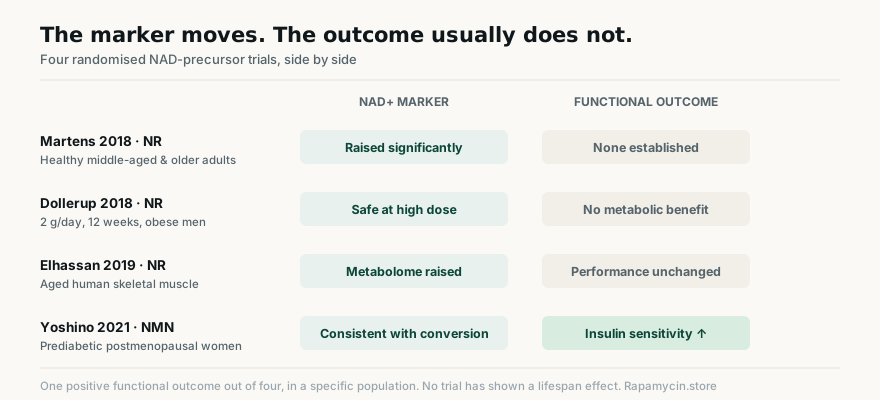
That is the pattern to hold in mind while reading any NMN sales page. The molecules do what they say on the mechanism — they raise the marker. What has not followed is the outcome. Yoshino's insulin-sensitivity result in prediabetic women remains the strongest functional finding in the whole category,[1] and it was a small trial in a specific population, not a general licence.
NMN compared with the alternatives
| Option | Human evidence | Typical cost | Honest verdict |
|---|---|---|---|
| NMN | Raises NAD+ markers; one positive insulin-sensitivity trial[1] | $$ | Plausible, earlier-stage, with an unsettled US regulatory status |
| NR | More randomised data; raises NAD+, well tolerated[4] — and null on metabolic outcomes at high dose[5] | $$ | The better-studied default; same outcome gap |
| Nicotinamide / nicotinic acid | Long-established NAD+ precursors | $ | Far cheaper route to the same marker; flushing and dosing considerations differ |
| NAD+ IV / patch | Little controlled longevity data | $$$$ | The weakest evidence-to-price ratio in the category |
Nothing in this table has been shown to extend human lifespan. They are ranked on evidence quality and cost, not on promise.
The FDA wrinkle buyers keep asking about
A regulatory question hangs over NMN in the United States. In 2022 the US FDA signalled that it no longer regarded NMN as a lawful dietary-supplement ingredient, on the grounds that NMN had earlier been investigated as a drug — which under US rules can exclude a compound from the supplement category. This prompted some retailers to change how they listed it. The precise, current status has been contested and may keep shifting, so we will not state a definitive 2026 position here. If you are buying in the US, check the current rules and the seller's own compliance before you purchase.
How to compare NMN supplements
Because no brand can honestly claim a proven longevity outcome, the sensible way to choose is on quality and transparency, not hype. Three things separate a serious NMN product from a weak one: independent third-party testing for purity and identity, a clearly stated dose per serving, and a delivery form matched to how you will actually take it. The table below compares NMN by form rather than by brand, because most NMN is sold under many small labels where genuine third-party testing is the exception, not the rule.
| Product | Evidence | Typical dose | 3rd-party tested | Best for | Not for | Price band | Link |
|---|---|---|---|---|---|---|---|
| Standard NMN capsules Sold under many labels | Early / mixed evidence | ~250–500 mg/day (label-dependent) | Not stated | Most people wanting a simple, measurable oral dose | Anyone who needs verified purity without checking a Certificate of Analysis | $$ · mid | |
| Sublingual / liposomal NMN Sold under many labels | Limited evidence | Varies; often lower stated dose | Not stated | People chasing better absorption claims | Anyone expecting absorption benefits to be proven — they mostly are not | $$$ · premium | |
| High-dose NMN Sold under many labels | Limited evidence | ≥600 mg/day (label-dependent) | Not stated | Experienced users following a clinician-guided protocol | Beginners, or anyone assuming more equals more benefit | $$$ · premium |
Affiliate links. We may earn a commission; it does not change our assessments.
"Not stated" in the third-party column reflects that most NMN forms are sold generically without a consistent, brand-level testing standard — ask any seller for a current Certificate of Analysis before trusting a purity claim.
How to actually read a Certificate of Analysis
"Third-party tested" is a phrase, not a guarantee. A COA worth trusting has four things, and you can check them in about a minute:
- A named independent laboratory — not the manufacturer's in-house lab, and not an unnamed "accredited partner."
- A batch or lot number that matches the bottle in your hand. A COA for a batch from two years ago tells you nothing about yours.
- Identity and purity by a real method — HPLC is the standard. "≥99% pure" with no method named is a marketing number.
- Contaminant testing — heavy metals and microbials, as separate line items with limits.
If a seller cannot produce that on request, you are buying a white-label powder with a logo on it. In a category sold on generic labels, this check does more for you than any brand ranking could.
What dose the evidence actually supports
Human NMN trials have generally used a few hundred milligrams per day, and the strongest functional result used a dose in that region.[1] The temptation is to assume more must be better. The NR literature argues directly against it: a 2 g/day arm produced no metabolic benefit over twelve weeks.[5] Paying a premium for a higher-milligram label is buying territory the trials suggest is empty. A clearly stated dose inside the studied range, from a batch you can verify, beats a bigger number every time.
Who NMN is not for
NMN is generally well tolerated in short trials at studied doses, but "well tolerated in a study" is not a personal all-clear. Long-term safety data are limited, and anyone who is pregnant or breastfeeding, has cancer or a serious health condition, or takes prescription medication should talk to a clinician before starting — we cover the specifics in NMN side effects. If you want the upside laid out just as carefully, see what the research on NMN benefits actually supports.
The bottom line
NMN is one of the more plausible longevity supplements because its mechanism is real and its early human data is encouraging — a marker moves, and one small trial showed a functional change. But the ceiling of honest claims today is "raises NAD+ markers, tolerable short-term, outcomes unproven." Buy on testing and transparency, keep your expectations calibrated to the evidence, and treat any page promising more than that with suspicion. For the fuller landscape of what raises NAD+, start with our evidence-first longevity guide.
Frequently asked questions
What is the best NMN supplement?
The best NMN supplement for most people is one that is third-party tested for purity, states an exact dose per serving, and is honest that its goal is raising blood NAD+ — a marker — rather than a proven health outcome. Compare by those three things, not by marketing.
Does NMN actually work?
NMN reliably raises NAD+-related markers in the blood in early human trials, and one small randomised trial reported improved muscle insulin sensitivity in prediabetic women. But that is a narrow result: large, long-term trials showing NMN makes healthy people live longer or healthier do not yet exist.
What is a good NMN dose?
Human studies have used a range of oral doses, commonly a few hundred milligrams per day. There is no established 'optimal' anti-ageing dose, so a clear, labelled dose per serving matters more than chasing the highest number. Discuss dose with a clinician if you have a medical condition.
Is NMN banned by the FDA?
In 2022 the US FDA took the position that NMN could no longer be lawfully sold as a dietary supplement, because it had earlier entered investigation as a drug. The practical and legal status has been contested and may differ by seller and region, so check current local rules before buying.
Is NMN or NR better?
Both are NAD+ precursors. Nicotinamide riboside (NR) currently has more published human trial data, including randomised evidence that it raises NAD+ and is well tolerated. NMN is promising but its human evidence base is earlier. Neither has proven longevity outcomes in people.
References
- Nicotinamide mononucleotide increases muscle insulin sensitivity in prediabetic women. Yoshino M et al. Science 2021;372(6547):1224–1229.
- Nicotinamide mononucleotide (NMN) — evidence summary. Examine.com.
- Nicotinamide riboside is uniquely orally bioavailable in mice and humans. Trammell SAJ et al. Nature Communications 2016;7:12948.
- Chronic nicotinamide riboside supplementation is well-tolerated and elevates NAD+ in healthy middle-aged and older adults. Martens CR et al. Nature Communications 2018;9:1286.Randomised, placebo-controlled; raised NAD+, no clear functional outcome.
- A randomized placebo-controlled clinical trial of nicotinamide riboside in obese men: safety, insulin-sensitivity, and lipid-mobilizing effects. Dollerup OL et al. American Journal of Clinical Nutrition 2018;108(2):343–353.12 weeks, 2 g/day: safe, but no improvement in insulin sensitivity or body composition.
- Nicotinamide riboside augments the aged human skeletal muscle NAD+ metabolome and induces transcriptomic and anti-inflammatory signatures. Elhassan YS et al. Cell Reports 2019;28(7):1717–1728.e6.Raised muscle NAD+ metabolites without a matching change in functional performance.
Own a longevity or health brand?
Rapamycin.store publishes sponsored and guest posts on an aged, topically-relevant domain, and offers display advertising. Tell us what you want to promote and we'll send our current options.