NAD+ boosters
Best NAD boosters and what actually raises NAD
Some NAD boosters genuinely raise NAD+ in people; most of the marketing runs far ahead of the evidence. Here is what actually raises NAD, by how much we can say, and where the proof runs out.
"NAD booster" covers several different products aimed at one target: NAD+, a coenzyme central to energy metabolism and cellular repair that declines with age. If the idea of NAD+ decline is new to you, start with what NAD is and why it falls with age. This page does the comparison — honestly ranking the options by the strength of their human evidence, not by how loudly they are sold.
What actually raises NAD in humans
The strongest human case belongs to nicotinamide riboside. A 2016 study showed NR is orally bioavailable and increases NAD+ metabolism in people,[1] and a randomised, placebo-controlled trial in middle-aged and older adults found chronic NR supplementation was well tolerated and significantly raised blood NAD+.[2] Independent summaries reach the same balanced conclusion: NR reliably lifts the NAD+ marker, while clear functional benefits remain unproven.[6]
NMN, the other leading precursor, has a smaller but encouraging human record — a small randomised trial reported improved muscle insulin sensitivity in prediabetic women.[5] Oral NAD+ itself is poorly absorbed, which is why precursors, not NAD+, are what people actually take.
NR raises NAD+ · outcomes still unprovenThe gap nobody in the category advertises
Here is the part that separates an evidence page from a sales page. The trials that raised NAD+ most convincingly are also the trials that failed to find a downstream benefit — and they are not obscure studies.
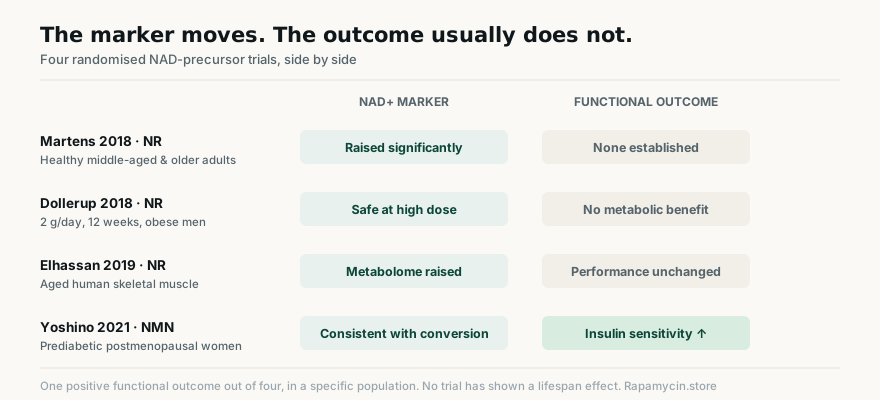
| Trial | Design | Did NAD+ rise? | Did anything else improve? |
|---|---|---|---|
| Martens 2018[2] | Randomised, placebo-controlled; NR in healthy middle-aged and older adults | Yes — significantly | Well tolerated; no clear functional outcome established |
| Dollerup 2018[3] | Randomised, placebo-controlled; 2 g/day NR for 12 weeks in obese men | Safe and tolerated at a high dose | No improvement in insulin sensitivity, lipid mobilisation or body composition |
| Elhassan 2019[4] | NR in aged human skeletal muscle | Yes — augmented the muscle NAD+ metabolome | Transcriptomic and anti-inflammatory signatures shifted; performance did not |
| Yoshino 2021[5] | Small randomised trial; NMN in prediabetic women | Consistent with precursor conversion | Yes — improved muscle insulin sensitivity. The strongest positive outcome in the category |
This is the honest shape of the field: the biomarker moves reliably, and the outcomes move rarely. Anyone telling you otherwise is selling something.
The Dollerup result deserves particular weight, because it is the outcome most often skipped in marketing copy. Participants took 2 grams per day — several times a typical commercial dose — for twelve weeks, and the trial reported no improvement in insulin sensitivity or body composition.[3] If the ceiling were a dosing problem, that study should have broken through it.
NR vs NMN vs topical and IV
It helps to segment the field. NR is the best-studied oral option and the one with a real third-party-testing pedigree through brands like Tru Niagen. NMN is a close conceptual cousin with thinner human data and its own regulatory and product-quality questions. NAD+ IV drips and transdermal patches are the most aggressively marketed and the least supported by controlled human research for longevity — they may raise NAD+, but the evidence that it is worth the cost is not there.[7] Rank by human data and the order is clear: NR first, NMN second, IV/patch last.
| Product | Evidence | Typical dose | 3rd-party tested | Best for | Not for | Price band | Link |
|---|---|---|---|---|---|---|---|
| Nicotinamide riboside (NR) Tru Niagen / Niagen | Early / mixed evidence | ~300 mg/day (studied range) | Yes | Most people who want the best-studied oral NAD booster | Anyone expecting proven anti-ageing outcomes, not just a raised marker | $$ · mid | |
| Nicotinamide mononucleotide (NMN) Sold under many labels | Limited evidence | ~250–500 mg/day (label-dependent) | Not stated | People wanting the other leading precursor with early data | Buyers who need a consistent third-party-tested brand and settled legal status | $$ · mid | |
| NAD+ IV drip / transdermal patch Clinic and label dependent | Limited evidence | Highly variable | Not stated | Those set on a non-oral route and willing to pay a premium | Anyone wanting evidence-backed value — the controlled data is thin | $$$ · premium |
Affiliate links. We may earn a commission; it does not change our assessments.
How to judge a NAD product
Since the category's ceiling is set by the evidence rather than the label, product selection comes down to not overpaying for a marker change:
- Third-party testing you can actually look up. A certificate of analysis tied to a named lab and a batch number, not a badge graphic.
- A dose inside the studied range. Roughly 250–1,000 mg/day for NR; 250–500 mg/day for NMN. Above that you are paying for territory the trials say adds nothing.[3]
- Single-ingredient where possible. Proprietary blends make it impossible to know what you took, and they exist to obscure exactly that.
- Cost per gram, not cost per bottle. Serving sizes differ enough to make headline prices meaningless.
- Outcome language on the label is a red flag. "Supports cellular energy" is regulatory boilerplate; "reverses cellular ageing" is a claim no NAD product has earned.
Who this is and is not for
A reasonable fit: someone who understands they are buying a well-tolerated biomarker intervention with an uncertain payoff, who has already covered the things with far better evidence — sleep, resistance training, protein intake, blood pressure — and who has budget left over.
A poor fit: anyone hoping to fix fatigue, anyone treating it as a substitute for the basics, and anyone on a tight budget. Cheaper NAD precursors exist, and the outcome data for the premium ones does not currently justify the premium.
What we can and cannot say
What we can say: the right NAD booster measurably raises NAD+ in the blood, NR does this in randomised trials with good tolerability, and NMN produced one genuine functional improvement in a small trial of prediabetic women.[5] What we cannot say: that any of these makes you live longer, feel more energetic, or slow ageing measurably — those claims outrun the data, and the higher-dose trials arguably argue against them.[3] If a seller promises outcomes rather than a marker change, that is the tell.
For the wider picture of how NAD fits alongside other longevity compounds, see best longevity supplements, our comparison of NMN vs NAD vs NR, and the evidence-first hub that keeps the same standard across the board.
Frequently asked questions
What actually raises NAD?
In humans, the best-supported oral route is a NAD+ precursor — nicotinamide riboside (NR) has randomised evidence that it raises NAD+ and is well tolerated, and NMN shows early signals too. Oral NAD+ itself is poorly absorbed, and IV or patch delivery is far less studied.
What is the best NAD booster supplement?
By weight of human trial data, NR (sold as Tru Niagen / Niagen) is the best-studied NAD booster and the one with a genuine third-party-testing track record. That makes it the sensible default, but 'best studied' still means it raises a marker, not that longevity outcomes are proven.
Do NAD boosters actually work?
They reliably raise NAD+-related blood markers in trials. What is not proven is that this translates into living longer, more energy, or slower ageing. Two of the better-designed randomised trials raised NAD+ successfully and still found no improvement in insulin sensitivity, body composition or muscle function. Treat NAD boosters as a plausible, marker-moving intervention with unproven clinical payoff.
Are NAD IV drips worth it?
The evidence is thin. NAD IV therapy and patches are marketed heavily but have little controlled human data behind them for longevity, and they cost far more than oral precursors. We list them as limited-evidence options, not front-line choices.
NR or NMN — which raises NAD more?
Both are converted to NAD+, and head-to-head human comparisons are limited. NR currently has more published randomised data in people; NMN has promising early results. Neither has been shown to extend human lifespan or healthspan.
How much NAD booster should I take?
Published human trials cluster around 250–1,000 mg per day for NR and roughly 250–500 mg per day for NMN. Higher is not established as better: one trial used 2 g/day of NR for 12 weeks and still found no metabolic benefit, which suggests the ceiling is not a dosing problem.
Do NAD boosters have side effects?
In randomised trials both NR and NMN have been well tolerated, with side effects generally no different from placebo — mild nausea, flushing or headache in a minority. The honest caveat is trial length: most run 6–12 weeks, so multi-year safety is simply unstudied.
Does niacin raise NAD too?
Yes — plain nicotinic acid and nicotinamide are also NAD precursors, and they are dramatically cheaper. Niacin causes flushing at higher doses, and high-dose nicotinamide has its own considerations, which is part of why the newer precursors are marketed instead. If your only goal is raising the NAD+ marker, the premium precursors are not the only route.
Should I take NAD boosters with resveratrol?
This pairing comes from sirtuin biology — the idea that NAD+ is the fuel and a sirtuin activator is the accelerator. It is a mechanistically tidy story with no human outcome trial behind the combination. Buying both doubles the cost and the assumptions.
References
- Nicotinamide riboside is uniquely orally bioavailable in mice and humans. Trammell SAJ et al. Nature Communications 2016;7:12948.
- Chronic nicotinamide riboside supplementation is well-tolerated and elevates NAD+ in healthy middle-aged and older adults. Martens CR et al. Nature Communications 2018;9:1286.Randomised, placebo-controlled; raised NAD+, no clear functional outcome.
- A randomized placebo-controlled clinical trial of nicotinamide riboside in obese men: safety, insulin-sensitivity, and lipid-mobilizing effects. Dollerup OL et al. American Journal of Clinical Nutrition 2018;108(2):343–353.12 weeks, 2 g/day: safe, but no improvement in insulin sensitivity or body composition.
- Nicotinamide riboside augments the aged human skeletal muscle NAD+ metabolome and induces transcriptomic and anti-inflammatory signatures. Elhassan YS et al. Cell Reports 2019;28(7):1717–1728.e6.Raised muscle NAD+ metabolites without a matching change in functional performance.
- Nicotinamide mononucleotide increases muscle insulin sensitivity in prediabetic women. Yoshino M et al. Science 2021;372(6547):1224–1229.
- Nicotinamide riboside (NR) — evidence summary. Examine.com.
- Nicotinamide mononucleotide (NMN) — evidence summary. Examine.com.
Own a longevity or health brand?
Rapamycin.store publishes sponsored and guest posts on an aged, topically-relevant domain, and offers display advertising. Tell us what you want to promote and we'll send our current options.